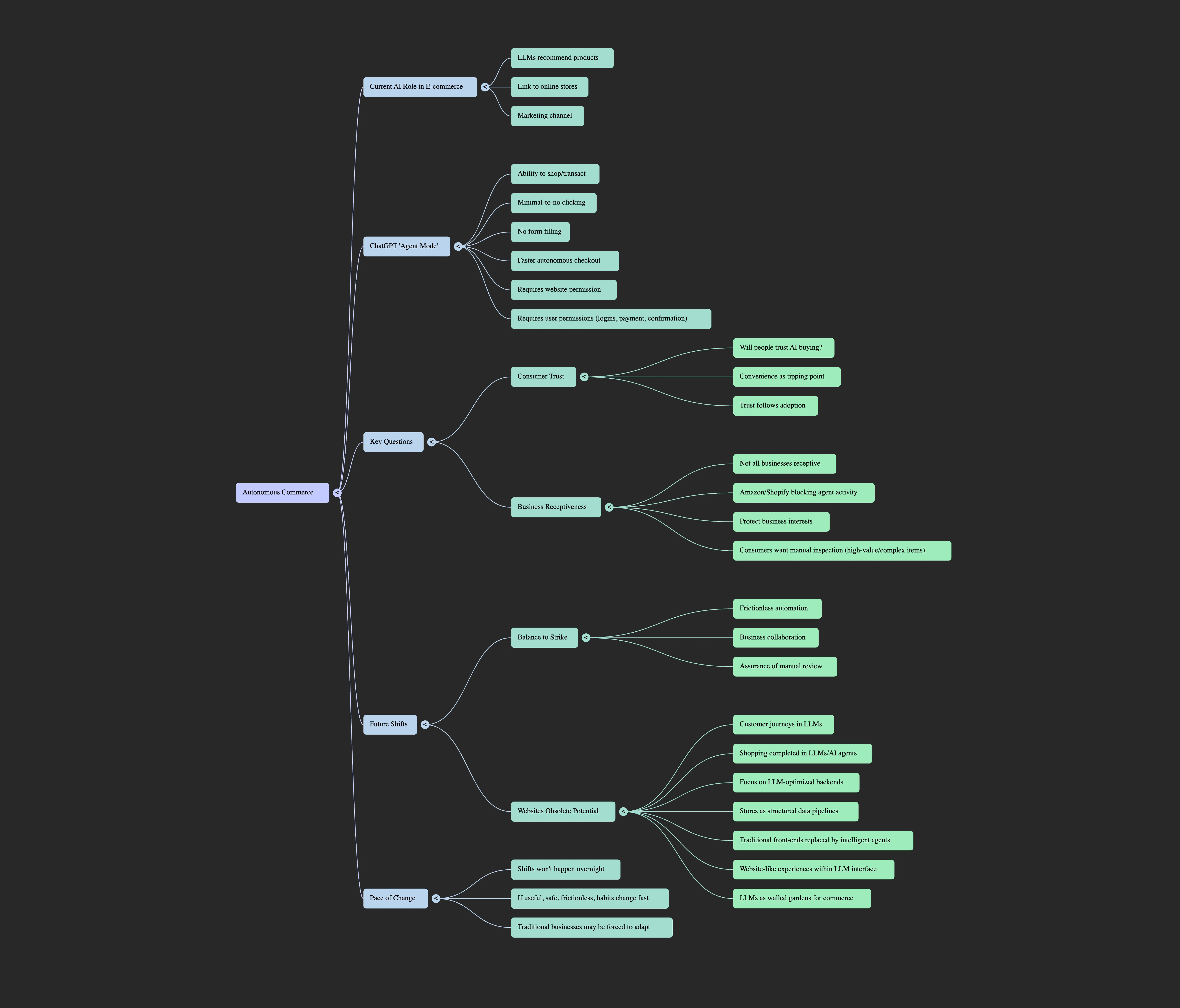
Right now, ChatGPT, Claude, Gemini, Perplexity and other LLMs (Large Language Models) can recommend products and link you directly to online stores. That alone has been a welcome marketing channel for many ecommerce businesses. But things are changing fast.
ChatGPTs 'Agent mode' (previously Operator) introduced a bigger leap with the ability to shop and transact on users' behalf, meaning minimal-to-no clicking, no form filling, and faster autonomous checkout experiences. That is, assuming the website allows it and you're willing to hand over permissions, such as logins, payment info, confirmation access etc.
Do we trust AI enough?
Consumer trust is always an important factor and raises a key question: will people actually trust AI to take over the buying process?
As with most technology shifts, the tipping point likely lies in convenience. If it’s easier to let an AI handle the shopping, many will opt in. And once enough people adopt it, trust tends to follow.
Will businesses play along?
However, not all businesses are receptive to AI agents. The likes of Amazon and Shopify are actively blocking this type of agentic shopping activity to protect their business interests. And in many cases, consumers still want to inspect high-value or complex items themselves before purchasing.
Therefore, there's a balance to strike between frictionless automation, business collaboration and the assurance of manual review. But it's clear that the pressure is building to streamline with so many consumers now using LLMs as search engines.
Websites could become obsolete
With the rise of AI adoption, it's becoming easier to imagine customer journeys and shopping experiences initiating (and even completing) directly inside LLMs or through AI agents. As a result, the future of ecommerce might not belong to those with the flashiest storefronts or best UX, but to those who build the smartest, most LLM-optimized backends.
Ecommerce stores could become little more than structured data pipelines for LLMs to consume, with traditional front-ends replaced by intelligent agents entirely, or by website-like experiences embedded within the LLM interface, offering users more manual control, and potentially greater convenience via an integrated all-in-one AI shopping platform. Essentially, LLMs become the walled gardens for commerce.
Are we ready?
These shifts won't happen overnight. But if AI and autonomous commerce continues to prove useful, safe, and frictionless, consumer habits may change faster than we expect. And traditional busineses models may have no choice but to play ball.